

Table of Contents
- Dressage vs Jumping Saddles: A Side-by-Side Comparison
- Seat Depth and Flap Design: The Core Structural Differences
- Knee Blocks, Thigh Blocks, and Rider Stability
- How Saddle Design Affects Horse Movement and Back Health
- Saddle Fitting for Different Disciplines
- Benefits of Custom Saddle Fitting for Dressage and Jumping
- Can One Saddle Work for Both Dressage and Jumping?
- Frequently Asked Questions
Last Updated: September 27, 2026
Dressage vs Jumping Saddles: A Side-by-Side Comparison
The dressage vs jumping saddle key differences come down to one idea: each design is built around what the rider's leg and seat must do. A dressage saddle puts you deep and long for quiet, driving aids. A jumping saddle keeps you flat and short so you can fold over a fence without catching a stirrup. At MacRider, we fit both types daily, and the riders who struggle most are usually on the wrong geometry for their discipline.
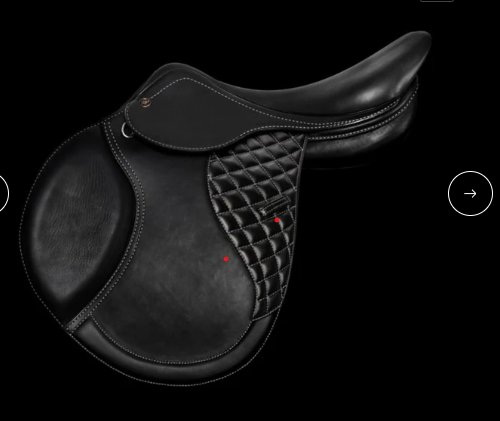
GP Pro Black
Quick Comparison Table
Feature |
Dressage Saddle |
Jumping Saddle |
|---|---|---|
Seat depth |
Deep to half-deep |
Flat to half-deep |
Flap angle |
Long, nearly vertical |
Forward, shorter |
Leg position |
Long, draped down |
Short, bent at knee |
Knee support |
Inside blocks, subtle |
Prominent front blocks |
Panel style |
Long, broad contact |
Short, close contact |
Best for |
Flatwork, lateral work |
Two-point, jumping |
Seat Depth and Flap Design: The Core Structural Differences
Seat depth and flap angle are the two measurements that decide everything else. A deep seat cradles your pelvis and holds it still. A flatter seat lets your hip open and close freely. Neither is better; they serve opposite jobs.
Deep Seat vs Flat Seat: How It Changes Your Pelvic Tilt
A deep seat encourages a neutral, upright pelvic tilt. That stability is what lets a dressage rider sit quietly through a half-halt without bracing. A flat seat lets the pelvis rotate forward over a jump, which is exactly what you want in two-point.
Riders coming from jumping often feel trapped in a deep seat at first. That feeling fades once the leg lengthens and the hip opens.
Long Flap vs Forward Flap: Lower Leg Position
A long flap drops your lower leg straight down, close to the horse's side, which supports subtle aids and lateral work. A forward flap shortens your effective leg so the knee bends and the lower leg stays secure over fences.
Get this wrong and everything unravels. A jumper on a long flap loses stability over a fence. A dressage rider on a forward flap cannot close the leg quietly.
Knee Blocks, Thigh Blocks, and Rider Stability
Knee rolls and thigh blocks are support, not decoration, and their placement changes how locked-in you feel. Dressage saddles usually use subtle inside blocks you can move on Velcro. Jumping saddles use larger front blocks, and some models place blocks on the outside of the flap.
The Ruby, our dressage model, uses outside blocks on the flap in a short or long configuration. The Olympic uses inside knee blocks on Velcro.

How Saddle Design Affects Horse Movement and Back Health
Most comparisons stop at the rider. The bigger story is what the tree and panel do to the horse's back, because that is where a wrong saddle shows up first, often before the rider notices anything.
The Biomechanical Chain: Tree Shape to Spinal Mechanics
The tree is the load-bearing frame. Its width at the gullet, its curve along the back, and its angle at the points all decide how your weight transfers into the horse's thoracolumbar region. When the tree is too narrow, the points press into the trapezius and the horse lifts its head, hollows, and shortens the stride. When the tree is too wide, the saddle sits down on the withers and the panels bridge, concentrating load under the stirrup bars instead of spreading it along the back.
Pressure Distribution, Wither Clearance, and Flocking
Gullet width and panel flocking decide how load spreads. A gullet that clears the spine by roughly four fingers keeps the withers free; anything tighter risks direct pressure. Wool flocking lets a fitter adjust the panel as the horse's topline changes with fitness and season, which is why many fitters prefer it over foam for horses in heavy work.
Reading the Horse's Feedback
Saddle Fitting for Different Disciplines
Saddle fitting for different disciplines starts with the horse and ends with the rider's leg. The horse's back profile and wither shape set the tree and panel. Your femur length, hip angle, and discipline set the seat and flap.
Benefits of Custom Saddle Fitting for Dressage and Jumping
The benefits of custom saddle fitting show up in three places: a quieter horse, a more stable leg, and a saddle that still fits next season. Off-the-rack saddles fit a narrow range of backs. Custom fitting matches the tree, panel, and flap to one horse and one rider.
Model |
Type |
Seat |
Price |
|---|---|---|---|
Dressage, mono-flap |
Half-deep |
$5,695.00 |
|
Ruby |
Dressage, mono-flap |
Half-deep |
$5,995.00 |
Grand Prix |
Jumping / trail |
Supportive |
$4,595.00 |
Grand Prix Pro |
Show jumping, double flap |
Flat |
$4,595.00 |
Berlin |
Jumping / trail |
Supportive |
$4,595.00 |
Can One Saddle Work for Both Dressage and Jumping?
One saddle can cover both disciplines if you accept a specific set of compromises. The question is not whether it works, it is which compromises you can live with.
The Four Compromises of a Multi-Purpose Saddle
Seat depth. A half-deep seat is the usual middle ground. It gives enough pelvic stability for flatwork without trapping you in two-point. It will feel vague in a collected canter and slightly insecure over a big oxer.
When One Saddle Is the Right Answer
If you school dressage two or three days a week and jump once, a multi-purpose saddle with an adjustable flap and a half-deep seat is a reasonable single-saddle answer. Adjustable trees, including carbon fiber models that a fitter can widen or narrow on the spot, extend that usefulness as the horse's shape changes.
When Two Saddles Are the Honest Recommendation
That is the trade-off in one line: versatility always costs a little precision, and the question is whether you will notice it in your riding.
Frequently Asked Questions
What are the primary structural differences between dressage and jumping saddles?
Dressage saddles have a deep seat, long straight flap, and knee blocks that hold the leg in a long, vertical position. Jumping saddles have a flatter seat, forward flap, and shorter stirrup bars to support a shorter stirrup length and two-point position over fences. These design choices affect rider alignment, pelvic tilt, and lower leg stability in each discipline.
Can you safely jump in a dressage saddle?
Jumping in a dressage saddle is not recommended. The deep seat and long flap restrict the rider's ability to get into a two-point position, and the stirrup bars sit further back, which can throw off balance over fences. For occasional cross-training, a multi-purpose saddle like the Grand Prix offers a safer middle ground, but serious jumping requires a dedicated jumping saddle.
How does saddle fitting for different disciplines affect horse comfort?
Saddle fitting for different disciplines must account for the horse's back shape and movement. A dressage saddle needs wither clearance and a gullet wide enough for spinal freedom during collection. A jumping saddle requires panels that allow the shoulder to rotate freely over fences. Custom fitting ensures pressure is distributed evenly, reducing the risk of back soreness and restricted movement.
What are the benefits of custom saddle fitting for serious riders?
Custom saddle fitting aligns the saddle to your horse's unique back profile and your own leg position. The benefits include improved rider stability, clearer aids, and less compensatory movement from the horse. Off-the-shelf saddles often cause pressure points that lead to resistance or lameness. A custom fit from a brand like MacRider, with adjustable trees and wool-flocked panels, can be re-fitted as your horse's muscling changes.
Do I need two different saddles if I ride both dressage and jumping?
Most riders who compete in both disciplines use two saddles because the seat depth, flap angle, and stirrup bar position serve different purposes. A dressage saddle supports a long leg and deep seat for lateral work and collection. A jumping saddle supports a shorter stirrup and forward balance over fences. A multi-purpose saddle can bridge the gap for low-level cross-training, but it compromises on both ends.
Choosing between a dressage and a jumping saddle is really a question about what your horse and your leg need to do most days, and getting it wrong costs both comfort and performance. MacRider builds dressage and jumping saddles with adjustable carbon fiber trees, 100% wool-flocked panels, and customizable flap options, backed by saddle fitting and trial services from our facilities in Wellington, Florida. Get started with MacRider and ride in a saddle fitted to your horse, not to a size chart.