
Last Updated: October 28, 2026
Quick Summary
To measure horse for saddle fit, start with the back: stand the horse square on level ground, run a flexible curve from withers to loin, and trace it onto paper. Measure from the back of the shoulder blade to the last rib, then check gullet width behind the shoulder blades with a gullet gauge.
- Stand the horse square on level ground so you avoid a crooked topline and bridging saddle.
- Mark the gap between the shoulder blades with chalk before measuring.
- Use a gullet gauge or flexible curve just behind the shoulder blades, not too far forward.
- Seat size is about the rider, not the horse, and most close-contact models run 17 to 18 inches.
- After mounting, check for even contact, no bridging, and free shoulder movement.
Table of Contents
- Step 1: How to Measure a Horse's Back for a Saddle
- Step 2: How to Measure Saddle Gullet Width
- Step 3: How to Measure Saddle Seat Size
- Frequently Asked Questions
Step 1: How to Measure a Horse's Back for a Saddle
Learning how to measure horse for saddle fit starts with the back, not the saddle, so begin by taking the time to measure horse anatomy carefully.
Stand the horse square on level ground, run a flexible curve from withers to loin, and trace it onto paper. Measure from the back of the shoulder blade to the last rib and note whether the back is flat, curved, or dipped.
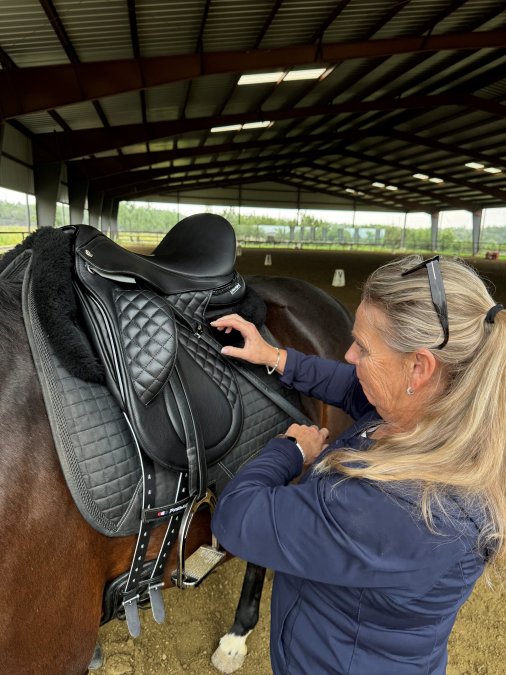
Mark the gap between the shoulder blades with chalk. For a deeper walkthrough, see our guide on how to measure a horse for saddle fit. A horse not standing square gives a crooked topline and a bridging saddle, so measure twice.
Step 2: How to Measure Saddle Gullet Width
Gullet width is the space under the pommel that clears the spine and withers. Use a gullet gauge or flexible curve just behind the shoulder blades, too far forward reads too wide.
The tree angle should sit close to the shoulder angle: too narrow pinches, too wide rocks and presses on the spine. If gullet width is hard to judge alone, our professional saddle fitting services are available.
Step 3: How to Measure Saddle Seat Size
Seat size is about the rider, not the horse. Measure from the pommel to the center of the cantle, or use leg length as a guide: longer legs need a larger seat.
Seat sizes run 17", 17.5", and 18" in most close-contact models; record yours with your back and gullet numbers. For help turning those numbers into a correctly fitting custom saddle, see our custom leather saddle fitting for jumpers guide. Then browse saddles built to that measurement, like the Olympic dressage saddle or the Burlington, both in 17" to 18" seats.


Measurement |
What It Tells You |
Tool |
Where to Check |
|---|---|---|---|
Back length |
Saddle panel footprint |
Flexible curve |
Shoulder blade to last rib |
Gullet width |
Spinal clearance |
Gullet gauge |
Behind the shoulder blades |
Seat size |
Rider fit |
Tape measure |
Pommel to cantle center |
After mounting, check for even contact, no bridging, and free shoulder movement. If the saddle lifts at the back or rocks, revisit the measurements.
Frequently Asked Questions
How do you measure a horse for a saddle?
Measure horse for saddle fit in three passes: run a flexible tape from the withers along the spine to find back length, use a flexible curve over the withers to record the angle and gullet width, and measure your own thigh length from hip to knee to set seat size. Have the horse standing square on level ground and repeat each measurement twice. Record everything so you can compare against a saddle's listed tree width and seat size before ordering.
What does a 17 inch saddle mean?
A 17-inch saddle refers to the seat size, measured from the front of the pommel to the center of the cantle, not the length of the whole saddle. It suits a rider whose thigh length measures roughly 17 inches from hip to knee. Seat size is a rider measurement, not a horse measurement, so it does not tell you whether the tree fits your horse's back. A 17-inch seat can sit on a wide tree or a narrow one.
Is a 7 inch gullet considered wide?
A 7-inch gullet is generally on the wider side for a horse saddle. Gullet width is measured across the front of the tree, from the inside edge of one side to the other, and it must clear the horse's withers and spinal column without pressing down. A horse with a broad, flat back may need something in that range, while a narrow, high-withered horse usually needs less. Use a flexible curve to confirm the actual shape before choosing.
Getting the numbers right is only half the job. The other half is matching them to a saddle built for your horse's back and your seat. MacRider offers quality saddles and bridles for every discipline, expert saddle fitting and trial services, and an exclusive product line you can try before you commit. Get started with MacRider and find a saddle that fits your horse the first time.
