
Table of Contents
- What Professional Saddle Fitting Actually Changes
- How to Tell If a Saddle Fits Properly: An At-Home Checklist
- Signs a Saddle Does Not Fit: What to Watch For
- How to Distinguish Saddle-Fit Problems from Other Causes
- What a Professional Saddle Fitter Does (and When to Call One)
- What to Document Before Contacting a Professional
- Why Professional Saddle Fitting Pays Off Long Term
- Frequently Asked Questions
Last Updated: October 14, 2026
What Professional Saddle Fitting Actually Changes
Professional saddle fitting matches a saddle's tree, panels, and balance to one horse's back and one rider's position. A poor fit concentrates weight over the withers, shoulders, and loin; a proper fit spreads pressure across the whole panel, stops rocking or slipping, and lets the horse move forward instead of bracing.
How to Tell If a Saddle Fits Properly: An At-Home Checklist
Run this basic fit check at home before calling a professional saddle fitter.
- With no pad, check the gullet clears the spine by four fingers and the withers have two to three fingers of clearance under the pommel
- Run your hand under the whole panel, any tight or hot spot is a pressure point
- Sit in the saddle; the deepest point should sit level, not tipped forward or back
- Ride a lap at the walk; the saddle should stay centered and not rock or slip
- Remove the saddle and check the back for sweat patterns and dry spots
Dry spots matter more than wet ones: a dry patch under a panel means no contact, so pressure is landing elsewhere. For a deeper look at how pressure and movement interact, the American Association of Equine Practitioners resources on equine back health are worth reading before you change anything.
Signs a Saddle Does Not Fit: What to Watch For
Behavior is the loudest signal a horse gives. During saddling: pinned ears, stepping away, biting or kicking at the girth, worsening girthiness. While riding: head tossing, hollow back, tail swishing with no flies, pawing, bucking or rearing, reluctance to move forward, shortened stride. After removing the saddle: back soreness along the panel line, uneven sweat or dry spots, white hairs or rubbed patches, swelling or heat. A cluster appearing every ride points hard at the saddle.
How to Distinguish Saddle-Fit Problems from Other Causes
Saddle fit is not the only cause of behavior change. Rule out the others first.
Possible Cause |
Telltale Sign |
How to Check |
|---|---|---|
Poor saddle fit |
Signs appear only when ridden in that saddle |
Try a different saddle, watch for change |
Teeth or mouth pain |
Head tossing with or without the saddle |
Have a vet or dental tech examine |
Ulcers or gut pain |
Girthiness, poor appetite, girthy even bareback |
Vet exam |
The clearest test is a swap: ride the same horse in a different saddle. If the behavior disappears, you have your answer. If nothing changes, book a vet before buying anything.
What a Professional Saddle Fitter Does (and When to Call One)
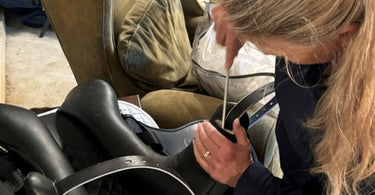
A professional saddle fitter checks the saddle on the horse, in motion, and under the rider, measuring tree width, panel contact, balance, and gullet clearance, then adjusting or recommending changes.

Call one when you see two or more behavioral signs at once, your horse's back shape has changed, you are buying a saddle, your saddle rocks or slips, or you have ruled out teeth, lameness, and ulcers with your vet. Fit changes over time, a saddle that fit in spring may not fit in fall.
What to Document Before Contacting a Professional
Gather these before you call: your horse's age, breed, height, and workload; back photos from both sides and behind; dated behavior notes; the saddle's brand, model, seat size, and tree width; sweat patterns photographed before brushing; recent changes (pad, girth, feed, training); and what your vet has ruled out. Bring the horse, saddle, and notes to the appointment. For riders who cannot get to an in-person fitting, remote guidance can still help. MacRider offers saddle fitting and trial services, along with a range of dressage saddles built for different back shapes. The Arlando suits normal-withered horses with a curved back, while the Burlington is built for high withers and large shoulders.
Why Professional Saddle Fitting Pays Off Long Term
The benefits of professional saddle fitting show up for the horse, the rider, and the checkbook. Even pressure means less pain and fewer behavior problems; a balanced saddle means a stable leg and better contact; and one correct fit beats three wrong saddles. Consistent fit checks catch small back changes that are easy to miss from the saddle. If you are unsure where to start, the American Veterinary Medical Association notes that back pain in horses often shows up first as a behavior change, not a visible injury. That is exactly why the saddle is worth checking early.
Frequently Asked Questions
What are the benefits of professional saddle fitting?
A professional fitting improves how weight is distributed across your horse's back, which supports comfort and movement. It also addresses behavior problems that trace back to pressure or pinching, such as girthiness, head tossing, or reluctance to move forward. Regular fittings keep the saddle matched to your horse as its shape changes with age, training, and condition.
How can poor saddle fit affect a horse's behavior?
Horses often show discomfort before they show injury. Watch for ears pinned back, tail swishing, pawing, biting at the girth, or bucking. Some horses simply slow down or refuse to move forward. These responses can come from pressure points along the withers, shoulders, or back, and they often fade once the fit is corrected.
How often should a horse's saddle fit be checked?
Check the fit at least twice a year, and after any change in your horse's weight, muscle, or workload. Young horses in training, horses coming back from time off, and horses changing disciplines need more frequent checks. A saddle that fit well last season may sit differently after a few months of condition changes.
Saddle fit problems rarely announce themselves. They build slowly, ride after ride, until the behavior becomes the norm.
MacRider can help you stop guessing. Our team offers expert saddle fitting services, a curated line of dressage saddles built for different back shapes, and trial options so you can check the fit before you commit. Get started with MacRider and put a saddle on your horse that actually fits.