

Last Updated: November 3, 2026
Quick Summary
The best equestrian gear for competitive riders starts with your discipline: dressage needs a deep, close-contact seat, while jumpers need a flat seat and forward flap. Build bridles and reins around your horse's head shape and your hand, and confirm every safety item meets your governing body's rules.
- Match the saddle to your primary discipline before comparing brands or prices.
- Build competition attire in three layers: wicking base, competition shirt, removable show jacket.
- Verify helmet certification on the permanent label inside the helmet, not just the listing.
- Book a saddle fitting at least four to six weeks before a show.
- Compare gear by cost per use rather than by initial purchase price.
Table of Contents
- Start With Your Discipline, Not the Brand
- Quick Comparison: Saddles, Bridles and Reins
- Equestrian Gear for Dressage and Jumping: Where the Two Diverge
- What to Wear to a Horse Competition: Layering by Phase
- Competition Riding Attire and Safety Equipment That Passes the Rules
- How the Best Equestrian Clothing Brands Differ in Fabric and Fit
- Budget Tiers and Cost Per Use on Tack and Apparel
- Book a Saddle Fitting Before Your Next Show
- Frequently Asked Questions
Start With Your Discipline, Not the Brand
The best equestrian gear for competitive riders starts with one question: what does your discipline actually demand? A dressage rider needs a deep, close-contact seat. A jumper needs a flat seat and forward flap. Buying by brand name before you answer that question is how riders end up with tack that fights them every stride.
Below, we break down saddles, bridles, reins, apparel, and safety equipment by discipline, budget, and competition rules, what to buy, what to skip, and where the money goes.
US Equestrian Federation rulebook
Quick Comparison: Saddles, Bridles and Reins
Here is the short version. Match the saddle to your primary discipline, then build the bridle and reins around your horse's head shape and your hand. Compare rubber reins that match the tack discussed here.

Item |
Best For |
Key Spec |
Price |
|---|---|---|---|
Olympic Dressage Saddle |
Dressage, normal withers |
Mono-flap, half-deep seat, carbon fiber tree |
$5,695.00 |
Grand Prix Jumping Saddle |
Jumping and trail |
Supportive seat, customizable flap |
$4,595.00 |
Grand Prix Pro Jumping Saddle |
Advanced show jumping |
Double-flap, flat seat |
$4,595.00 |
Snaffle On Top Bridle |
Daily training and competition |
Anatomical headpiece, on-top buckles |
$495.00 |
Snaffle Cut Back Bridle |
Horses with sensitive ears |
Extra ear clearance |
$475.00 |
Double Bridle On Top |
Upper-level dressage |
Tapered noseband, click browband |
$595.00 |
Rein with Stops Deluxe |
Precision contact |
Spaced leather hand stops |
$160.00 |
Dressage Stirrups |
Close contact under the leg |
Single-length leather, nylon core |
$165.00 |
Curved Dressage Girth |
Horses prone to girth rubs |
Asymmetrical contour |
$250.00 |
If you are unsure whether your current saddle fits, check it against your horse's back and your position before you compare anything else. Read about signs your jumping saddle fits poorly before committing to a comparison.
Equestrian Gear for Dressage and Jumping: Where the Two Diverge
Dressage and jumping tack diverges in three places: seat depth, flap angle, and knee support. Everything else follows from those.
The Olympic dressage saddle shows the pattern: a half-deep seat and narrow twist support a close leg position, and the mono-flap design removes bulk. Velcro-attached inside knee blocks are adjustable, and the open pommel gives the horse shoulder freedom.
Jumping saddles work differently. The Grand Prix Pro uses a flat seat and double flap, designed for maximum rider fluidity over fences. Seat comfort comes in normal, soft, or extra soft, and flap length and forward projection are customizable.
If you genuinely split your time, the Grand Prix multi-purpose model is designed for both the jumping arena and recreational trail riding, with a supportive seat and a stable, secure fit.
For a deeper breakdown of how the two designs differ, see our guide to dressage versus jumping saddles.
What to Wear to a Horse Competition: Layering by Phase
What you wear to a horse competition depends on the phase, not the forecast. Build three layers: a moisture-wicking base, a competition shirt, and a show jacket you can remove between classes.
Start with breeches or riding tights in a technical four-way stretch fabric. Full-seat options give grip in the tack; knee-patch options feel cooler in summer heat. Add a polo for schooling and warm-up, then switch to a competition shirt with a stock tie for the ring.
The jacket matters more than riders expect. A tailored show jacket that restricts your shoulders will show up in your test. Look for a soft shell or technical fabric with a stretch panel across the back. Shadbellies suit dressage; hunt-seat riders typically wear a traditional show coat.
Boots should be broken in before show day, not on it. Tall leather field boots with a defined heel meet most competition requirements. Half chaps over paddock boots work for schooling but check the rules for your division.
Competition Riding Attire and Safety Equipment That Passes the Rules
Safety equipment must meet the standard your governing body requires, and helmets are the item most often checked. "Certified" is not a single thing, standards differ by testing body and intended use, and a helmet legal for one division may not satisfy another.
How to verify helmet compliance. Look for a permanent label inside the helmet listing the standard and testing body. Common equestrian standards include ASTM International and the Snell Memorial Foundation, and many helmets also carry a CE mark.
Fit is part of compliance. A certified helmet that does not fit will not protect you. Fit it snugly with the chin strap fastened, then open your mouth wide; if the helmet lifts, it is too loose. Re-check the harness after your warm-up, since a helmet that fits in the tack shop can shift once you are mounted and sweating.
Protective vests. Body protectors are mandatory for cross-country phases in eventing and optional elsewhere. Look for a vest certified to a recognized standard and check your rulebook for whether that standard is accepted in your division. Fit should be close to the body without restricting your seat or your ability to remount; too long a vest catches the saddle cantle, and too short a one rides up.
Attire rules by discipline. Competition attire rules vary by division and level, and the differences matter more than most riders expect. Most divisions require:
- A certified helmet with the harness fastened at all times mounted
- Boots with a heel and a smooth sole
- A shirt with sleeves, plus a jacket for the ring in most divisions
- Hair secured and out of the rider's face
- Spurs and whips within the length limits set for your division
Dressage divisions typically require a stock tie and a shadbelly at upper levels, while hunt-seat divisions follow a different jacket convention. Eventing adds a cross-country phase with its own safety requirements. Double bridles are permitted only at the levels your rulebook specifies, and the bit and noseband combination must comply. View the Double Bridle Anatomic for an anatomical option.

Build a compliance check into your show prep. Two weeks out, read the rulebook section for your exact division and level, list every required item, and check each against its label or spec: helmet certification, vest standard if applicable, boot heel and sole, spur and whip length, and bit and noseband legality. Keep copies of the relevant rulebook pages with your show kit, a labeled certification and a rulebook citation resolve a steward's question faster than a brand name.
US Equestrian Federation rulebook
How the Best Equestrian Clothing Brands Differ in Fabric and Fit
The best equestrian clothing brands differ less in styling than in fabric weight, stretch recovery, and pattern cut. Two jackets can look identical on a hanger and feel completely different in the saddle. Compare specification versus specification, not brand versus brand, because the same brand can get it right in one garment and wrong in another.
Fabric weight and construction. Competition apparel usually comes in three families: woven soft-shell (wind and light rain resistance, lower stretch), knit technical jersey (high stretch, high breathability, less structure), and bonded or laminated fabrics (structured fronts with a stretch back panel). Ask for the grams-per-square-meter weight if listed: a 180-220 gsm summer show coat feels very different from a 300 gsm coat built for cold-weather warm-ups. Heavier is not better, it is different, and the phase you ride in should drive the choice.
Stretch recovery. Recovery is how completely a fabric returns to its original shape after stretching, and it separates apparel that lasts from apparel that bags out. Breeches with poor recovery develop knee bags and a sagging seat within a season.
Breathability and moisture management. Breathability lets water vapor escape; moisture management moves liquid sweat away from skin to evaporate. A jacket can be breathable and still feel clammy if the lining does not wick. For summer competition, prioritize a mesh or perforated back panel and a wicking base layer.
Pattern cut and fit. Fit is where cheaper apparel gives itself away. Look for gusseted crotches, articulated knees, and a waistband that sits without digging in two-point position. Check three measurements before you buy: rise, inseam, and knee-patch placement, a patch above or below your actual knee will rub and restrict.
Independent testing criteria. Brand descriptions are not testing.
Leather care belongs in this conversation too. Saddles and bridles built from premium leather last longer when cleaned after every ride and conditioned regularly. Soft Italian leather like the Olympic's breaks in faster but still needs protection from sweat and grit.
Budget Tiers and Cost Per Use on Tack and Apparel
Cost per use is the honest way to compare equestrian gear. A $160 pair of reins used four times a week for three seasons costs less per ride than a $60 pair replaced every year.
We group purchases into three tiers:
Entry tier. Paddock boots, riding tights, a certified helmet, and a snaffle bridle. This covers schooling and low-level competition.
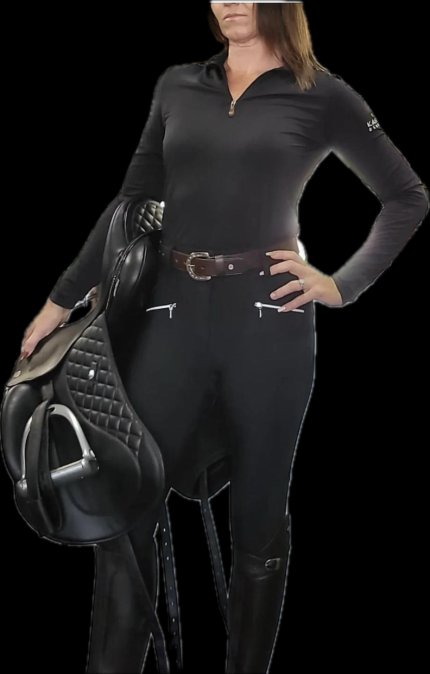
Core tier. A discipline-specific saddle, a competition jacket, tall boots, and a second bridle. This is where most serious amateurs land.
Premium tier. Custom flap options, anatomical bridles, and a saddle fitted professionally to your horse. The Olympic at $5,695.00, the Grand Prix at $4,595.00, and the Double Bridle On Top at $595.00 sit here.
The mistake we see most often is spending premium money on a saddle before confirming fit. A $4,595.00 saddle that does not fit your horse is worse value than a mid-range saddle that does.
Book a Saddle Fitting Before Your Next Show
Book a saddle fitting at least four to six weeks before a show, not the week of. Horses change shape with conditioning, and a saddle that fit in the off-season can pinch once your horse builds topline.
Saddle fitting and trial services are offered from our facilities in Wellington, Florida. Learn what professional saddle fitting involves.
American Association of Equine Practitioners on saddle fit and back health
Getting your gear right is not about buying the most expensive tack on the shelf. It is about matching saddle, bridle, and apparel to your discipline, your horse's shape, and the rules you compete under. MacRider offers saddles and bridles for dressage and jumping riders, an exclusive product line, and saddle fitting and trial services from our facilities in Wellington, Florida. Get started with MacRider and ride into your next show on tack that fits you and your horse.
Frequently Asked Questions
What gear does a competitive equestrian need?
MacRider offers saddles, bridles, reins, stirrups, and girths for dressage and jumping riders. MacRider's listed saddles range from $4,595.00 to $5,695.00, bridles from $475.00 to $595.00, and the Rein with Stops Deluxe is $160.00.
What to wear to a horse competition?
Plan in layers by phase. Check your governing body's rulebook for the required attire for your discipline and level before you pack.
How do I choose equestrian gear for my discipline?
Start with the saddle. The Olympic is a close-contact, mono-flap dressage saddle designed for horses with a normal wither and a slightly flat back profile. The Grand Prix Pro is a double-flap jumping saddle with a flat seat. Fit the horse first, then the rider.
What safety gear should I wear when horseback riding?
Choose a helmet certified to a recognized safety standard and confirm your governing body accepts it for your division, then check your rulebook for other required protective equipment.
Do I need separate tack for dressage and jumping?
Not always. A multi-purpose saddle like the Grand Prix is built to work in the jumping arena and on the trail, so a rider who competes at lower levels in both disciplines can use one saddle. The two disciplines have different seat and flap designs, which is why the Olympic and Grand Prix Pro are built differently.
