
Last Updated: November 1, 2026
Quick Summary
Custom saddles are worth the investment because they are built to your horse's conformation and your position, distributing pressure evenly instead of concentrating it. An adjustable tree and wool-flocked panels let the saddle be re-fitted as your horse's topline changes, extending its life and resale value.
- A saddle built to your horse's back shape spreads pressure across the panels rather than concentrating it.
- Custom fitting measures the horse, the rider, then selects a tree and panel configuration.
- Adjustable trees and wool flocking allow re-fitting as the horse's condition changes.
- Compare saddles on total cost of ownership: acquisition, fitting, maintenance, re-fitting, and resale.
- A custom saddle bought without a documented fitting is the most expensive mistake in this category.
Table of Contents
- Why Custom Saddles Are Worth the Investment
- The Benefits of Owning a Custom Saddle
- Custom Saddle Fitting: How the Process Actually Works
- Custom Saddle Cost: What You Pay For and What It Returns
- How to Choose a Saddle Maker
- Custom Saddle Resale Value and Long-Term Ownership
- Materials, Craftsmanship, and the Options Compared
- Book a Saddle Fitting Before You Buy
- Frequently Asked Questions
Why Custom Saddles Are Worth the Investment
A poorly fitting saddle changes how your horse moves, how your leg sits, and how precisely you can communicate an aid. Custom saddles address that at the source. This guide explains what goes into a custom saddle price and what the fitting process involves.
A horse's back changes shape with age, training, and condition, and a fixed off-the-rack panel cannot follow those changes. A custom-built saddle is measured to your horse's conformation and your position. Adjustable trees and wool-flocked panels allow the fit to be changed over time.
The Benefits of Owning a Custom Saddle
The first benefit is fit stability. A saddle built to your horse's back shape distributes pressure across the panels instead of concentrating it under the gullet or behind the shoulder.
The second benefit is longevity. The tree is adjustable and the wool-flocked panels can be re-flocked, which allows the saddle to be re-fitted as your horse's topline changes.
Rider Comfort and Position
Rider position is not vanity. A saddle that puts your leg in the wrong place forces you to compensate with your hip, knee, or ankle, and that compensation travels down the rein into the horse. Custom saddles let you specify seat depth, twist width, flap length, and block placement so your leg falls where it naturally sits.
On MacRider's close-contact mono-flap models, the inside knee blocks sit on Velcro and can be adjusted to match your leg position. A narrow twist keeps the leg close and quiet.
Horse Comfort and Saddle Fit
Horse comfort comes down to spinal clearance and panel contact. A gullet that is too narrow presses on the withers; a panel that bridges leaves a gap under the cantle and concentrates load at the front. Custom fitting measures both, then builds to the numbers rather than to a size label.
Buying off the rack based on seat size alone can lead to a poor fit, because seat size describes the rider while tree width and panel shape describe the horse. For a deeper guide on how to choose a dressage saddle that fits you and your horse, including seat size, measuring, and trials, see the full fit guide. Seat size describes the rider. Tree width and panel shape describe the horse. They are unrelated measurements.
Custom Saddle Fitting: How the Process Actually Works
Custom saddle fitting is a measured, multi-step process that typically assesses the horse's back and conformation, measures the rider, selects a tree and panel configuration, and re-checks fit under saddle at the walk, trot, and canter. Professional saddle fitting in Florida covers the signs a saddle does not fit, saddle fitting cost, and how to measure a horse for a saddle.
A typical fitting follows these steps:
- Static assessment: wither shape, back profile, shoulder clearance, and symmetry are recorded with the horse standing square.
- Rider measurement: seat size, thigh length, and hip width determine flap length and block position.
- Tree and panel selection: width, gullet clearance, and flocking type are matched to the assessment.
- Dynamic check: the saddle is observed under saddle, with the rider mounted, at all three gaits.
- Adjustment: flocking is added or removed and the tree is tweaked until pressure is even.
Custom Saddle Cost: What You Pay For and What It Returns
Custom saddle cost is real money, but the purchase price is only the first line item. Fitting visits, adjustments, maintenance, repairs, and eventual replacement all sit on the same ledger, and a saddle that can be re-fitted changes every one of those lines after year one.
What the ticket actually covers
A custom saddle price is typically built from several components:
- The tree. This line uses an advanced carbon fiber tree, adjustable on the spot.
- The panels and flocking. Panels are short back panels, 100% pure wool-flocked.
- The leather. Premium, ultra-soft Italian leather is used in this product line.
- The maker's labor. Seat depth, twist width, flap length, and block placement are hand-built to your specification, not pulled from a size chart.
The lifetime cost ledger
A useful way to compare a custom saddle against an off-the-rack saddle is to total the cost of ownership over the years you expect to ride the same horse, and then over the horses that follow. To judge what your money returns, compare high performance jumping saddle reviews for balance, fit, and value.
Cost line |
Off-the-rack, fixed tree |
Custom, adjustable tree and wool flocking |
|---|---|---|
Initial purchase |
Lower |
Higher |
First fitting and re-check |
Often extra, sometimes skipped |
Usually bundled into the purchase |
Re-fitting as the topline changes |
Not possible; replacement or rebuild |
Routine flocking and tree adjustment |
Maintenance (cleaning, leather care, hardware) |
Similar |
Similar |
Repairs (billets, stitching, flocking top-ups) |
Similar, but panel work is limited |
Wool panels can be re-flocked rather than replaced |
Replacement cycle |
Shorter if the horse changes shape |
Longer, because the same saddle follows the horse |
Resale |
Narrower pool of buyers |
Wider pool, because the saddle can be re-fitted to a different horse |
How to budget realistically
Riders may find it useful to plan for three cost categories:
- Acquisition. The saddle itself plus any fitting appointments not bundled into the price.
- Ownership. Routine cleaning and leather care, periodic flocking checks, and hardware repairs.
- Fit events. Re-flocking and tree adjustments after significant changes in the horse's condition, plus a re-check if the horse goes lame or comes back into work after time off.
When comparing makers, it can help to ask for the acquisition price and the cost of re-flocking and adjustment visits separately.
How to Choose a Saddle Maker
When choosing a saddle maker, it helps to ask whether they can show you the tree and panel construction, how they fit the saddle to your horse, and what support is available as the fit changes over time. If you are looking for a Dover Saddlery alternative for custom tack, you can explore custom saddles, bridles, and fitting services built around your horse's measurements.
Useful things to look for in a maker include an adjustable tree, wool flocking so panels can be re-shaped, and a clear after-sale adjustment policy.
Custom Saddle Resale Value and Long-Term Ownership
Custom saddle resale value depends on factors such as whether the saddle has an adjustable tree and how well it has been maintained.
How depreciation actually works
Three factors drive how much value survives:
- Adjustability. An adjustable tree and wool panels mean a buyer can make the saddle fit their horse, keeping the resale pool wide.
- Condition and documentation. Service records, re-flocking history, and leather care matter to a buyer the way a service history matters on a used vehicle.
Resale is best viewed as a recovery of part of the purchase price rather than an investment return.
Custom, semi-custom, and adjustable: which one fits your situation
Not every rider needs a fully bespoke build. The right choice depends on the horse's shape, how much that shape is likely to change, your budget, and how far you are from a qualified fitter. Use this decision framework:
Your situation |
Best-fit option |
Why |
|---|---|---|
Horse has an unusual back profile (very short-backed, high-withered, asymmetric) |
Fully custom |
Only a measured build can match the conformation |
Horse is young, in training, or likely to change condition |
Custom or semi-custom on an adjustable tree |
The tree and panels can follow the change |
Rider has specific positional needs (seat depth, twist, block placement) |
Custom or semi-custom |
Off-the-rack cannot match rider geometry |
Budget is tight and the horse is a stable, average shape |
Quality adjustable off-the-rack, professionally fitted |
You get re-fit capability without the bespoke ticket |
You are far from a qualified fitter |
Maker with a documented remote fitting process and a trial period |
Fit must be verifiable before final payment |
You change horses often |
Adjustable tree with wide re-fit range |
One saddle can serve multiple horses |
The key distinction is that "custom" and "adjustable" are not the same thing. A semi-custom saddle built on an adjustable tree with wool flocking can deliver most of the re-fit benefit at a lower price than a fully bespoke build. What you should not accept is a fixed tree with no re-fit path.
Long-term ownership: the re-fit cycle
Plan on a re-check whenever the horse's condition changes materially: after a seasonal weight shift, a layoff and return to work, or a change in training intensity.
Materials, Craftsmanship, and the Options Compared
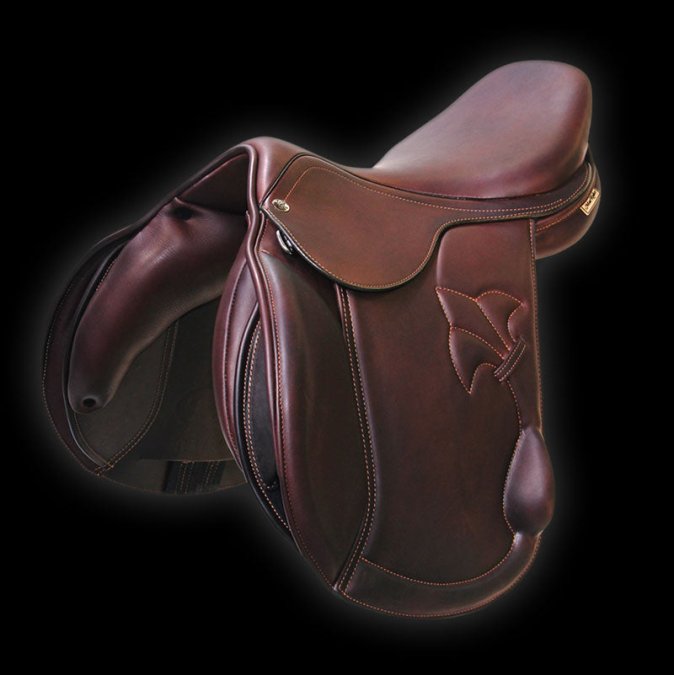
Materials and craftsmanship affect how a saddle performs over time. The tree is an advanced carbon fiber tree that is adjustable on the spot.
The saddles use premium, ultra-soft Italian leather and wool-flocked panels.
Our own line illustrates how the options differ by horse:
- The Challenge Triple Star is built for medium-to-high withered horses with a normal back profile, with short wool-flocked panels and a generous gullet.
- The Majestic is designed for normal-withered horses with a curved back profile, with inside knee blocks on Velcro.
- The Arlando is optimized for very short-backed horses, with outside blocks for external leg stability.
- The Regent has an extra-wide channel design for spinal clearance.
Each is a close-contact mono-flap design with a narrow twist, standard 16-inch flap, and seat sizes from 17 to 18 inches in black, brown, or navy.

Book a Saddle Fitting Before You Buy
Fitting before purchase is a sensible order of operations for a custom saddle.
Riders considering a custom purchase may want to have the fit assessed before purchase. At MacRider, we offer saddle fitting and trial services alongside our exclusive product line.
Get started with MacRider and ride in a saddle built to your horse's measurements, not a size label.
Frequently Asked Questions
Are custom saddles worth the investment?
For a rider who competes or rides several times a week, custom saddles usually pay for themselves through better fit and longer service life. A saddle that matches your horse's back shape and your own position reduces pressure points and the need to keep replacing off-the-rack tack that never quite works. The value shows up in comfort, fewer adjustments, and stronger resale than a mass-produced saddle of the same age.
How much does a custom saddle cost?
Expect to pay in the region of $5,000 to $6,000 for a premium close-contact model. At MacRider, the Majestic, Arlando and Regent are $5,995.00 each, and the Challenge Triple Star is $5,895.00. That price covers the carbon fiber tree, wool-flocked panels, Italian leather and fitting support. Budget separately for a fitting appointment and any later flocking adjustments.
How long does it take to get a custom saddle made?
The build itself is only part of the timeline. Measurements and a fitting typically come before the saddle is built. Ask any maker for a written lead time and confirm what trial or adjustment terms apply before paying a deposit.
Do custom saddles hold their value when resold?
They generally hold value better than off-the-rack saddles because the tree, leather and panels are built to last and the brand is known to fitters. Resale depends on condition, size and how well the saddle was maintained. Keep your receipts and maintenance records, and store the saddle properly.
