
Table of Contents
- What You'll Need Before You Measure
- Step 1: Find the Last Rib and Set Your Back Length
- Step 2: Check Wither Clearance and Gullet Channel
- Saddle Gullet Width Measurement: Matching Tree Width to Shoulder
- How to Check Saddle Fit With a Wither Tracing
- Signs of Poor Saddle Fit in Horses
- Static vs. Dynamic Fitting: What Changes When Your Horse Moves
- Conclusion
- Frequently Asked Questions
Last Updated: September 23, 2026
What You'll Need Before You Measure
Measuring a horse for saddle fit starts with the right tools and a calm, square-standing horse. Get these ready before you touch the animal.
You'll need:
- A flexible measuring tape (cloth, not metal)
- A piece of wire or a flexible curve for tracing
- A level surface to stand your horse on
- A helper to hold the horse steady
- A notebook to record every number
The tools are cheap. The accuracy they give you is not.
Here's what most guides get wrong: they jump straight to numbers. But a horse that won't stand still gives you readings you can't trust. Take five minutes to settle your horse first.
The American Association of Equine Practitioners welfare guidelines stress calm handling for any fitting work. A relaxed horse gives you a true measurement.
Step 1: Find the Last Rib and Set Your Back Length
Back length is the distance from the base of the withers to the last rib. This tells you how much saddle your horse can carry without pressure on the loin.
Finding the last rib takes a light touch. Run your fingers down the horse's side until the ribs stop. The last rib sits just behind the saddle area. Mark it with chalk.
Then measure forward to the wither. Use your flexible tape along the spine. Record the number in inches.
A common mistake is measuring too far back. The loin is weak and cannot bear weight. A saddle that extends past the last rib will bridge and dig in.
Measurement |
Where to Start |
Where to Stop |
Why It Matters |
|---|---|---|---|
Back length |
Base of withers |
Last rib |
Stops the saddle pressing the loin |
Gullet width |
Front of withers |
Front of withers |
Sets tree width |
Wither clearance |
Top of withers |
Underside of pommel |
Prevents pinching |
Keep this table handy. You'll fill it in as you go.
Step 2: Check Wither Clearance and Gullet Channel
Wither clearance is the gap between the top of the withers and the underside of the pommel. You want two to three fingers of space. Any less, and the saddle digs in.
Gullet channel width matters just as much.
Saddle Gullet Width Measurement: Matching Tree Width to Shoulder
Saddle gullet width measurement is the process of finding the angle and width of the gullet so the tree matches the horse's shoulder. Get this wrong and no amount of padding will fix it.
Reading the Angle, Not Just the Width
Gullet width and gullet angle are two different numbers, and most buyers confuse them.
- Width is the distance between the two points of the tree at the front, measured in inches or centimeters.
- Angle is the degree of flare from the gullet down to the points, usually expressed in degrees.
Common Angle Ranges by Build
Most practitioners find that shoulder angles cluster into rough ranges by build:
- Narrow, high-withered builds (many Thoroughbreds) often sit in the steeper range.
- Round, mutton-withered builds (many Quarter Horses and draft crosses) often sit in the flatter range.
- In-between builds (Warmbloods, many sport horse crosses) fall in the middle.
Why Breed Conformation Changes the Answer
A high-withered Thoroughbred and a mutton-withered Quarter Horse can share the same back length and still need completely different trees.
- High withers need a tree with more wither clearance and a narrower gullet, or the pommel sits on the spine.
- Mutton withers need a flatter, wider tree with a broader panel surface, or the saddle rolls side to side.
- Prominent shoulder blades need a tree angle that follows the scapula's slope, or the points dig in at the walk.
The Shoulder Blade Moves Under the Tree
The shoulder blade rotates back and up with every stride. So the angle must follow the shoulder, not fight it. A tree that is one size too narrow will look fine standing still and pinch the moment the horse walks off.
It's the step most online buyers skip.
How to Check Saddle Fit With a Wither Tracing
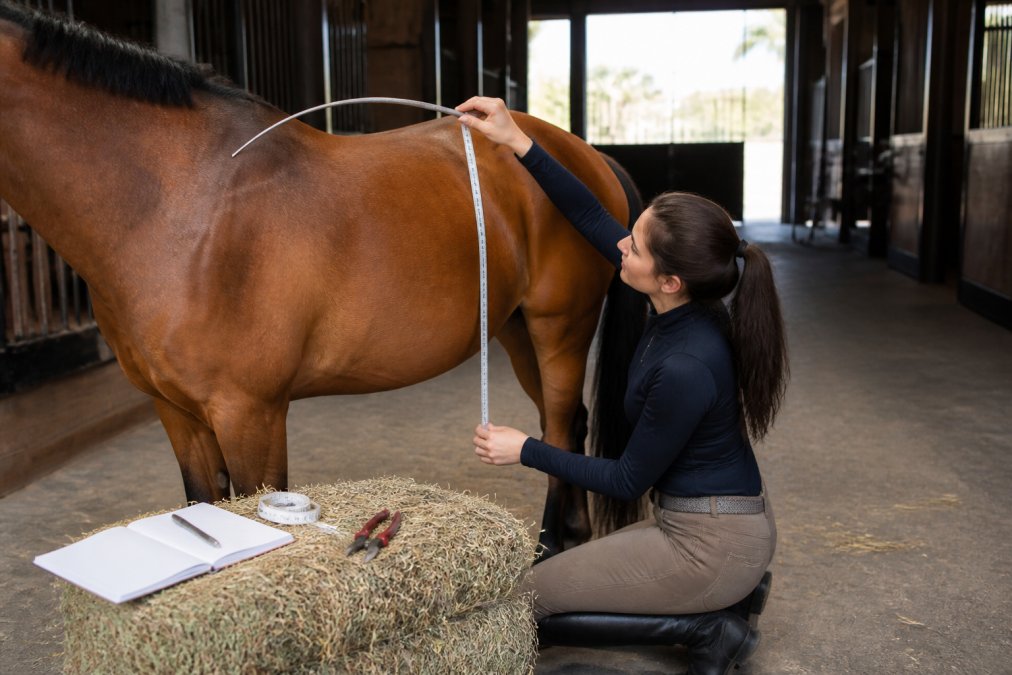
- Bend your wire or curve over the withers, just behind the shoulder blade.
- Press it down gently until it touches both sides evenly.
- Lift it off without changing the shape.
- Lay it on paper and trace the inside edge.
- Repeat at three points: behind the shoulder, mid-back, and over the last rib.
Trace Both Sides, Then Compare Them
Most guides tell you to trace the withers. Almost none tell you to trace each side separately and compare. That comparison is where the real information lives.
- Matching curves mean a symmetrical tree will work.
- One side steeper than the other means the horse has uneven muscling or a shoulder that sits lower.
- One side flatter or hollowed often points to muscle atrophy, frequently on the side the horse carries less weight on or the side a poorly fitting saddle has been pressing.
What to Do With an Asymmetric Tracing
You have three practical options, and none of them is 'ignore it.'
- Shim the flatter side. A thin shim under the panel on the hollow side can level the saddle. Keep shims thin and recheck often, because a shim that is too thick creates its own pressure point.
- Choose a saddle with adjustable flocking or interchangeable gullet plates. These let a fitter tune each side independently rather than forcing the horse into a symmetrical tree.
- Address the underlying cause. If the asymmetry comes from muscle atrophy, a veterinarian or equine bodyworker can help you build the muscle back. As the muscle returns, the tracing changes, and the saddle needs rechecking.
Breed Conformation Shows Up in the Tracing
The tracing also reveals breed-linked shape differences that a tape measure alone cannot show.
- A high-withered Thoroughbred tracing shows a tall, narrow peak with steep sides. That shape needs a tree with deep wither clearance and a narrower gullet.
- A mutton-withered Quarter Horse tracing shows a low, broad, rounded curve. That shape needs a flatter tree with a wider panel surface so the saddle does not roll.
- A Warmblood or sport horse cross often shows a moderate peak with a longer, flatter back. That shape needs a tree that follows the longer slope without bridging at the loin.
Signs of Poor Saddle Fit in Horses
Signs of poor saddle fit in horses show up long before the horse refuses to work. Catch them early and you avoid months of rehab.
Watch for these:
- White hairs or bald patches under the saddle area
- Dry spots after a ride where sweat should be even
- Head tossing, tail swishing, or pinned ears when you girth up
- Hollow back or a shortened stride
- Reluctance to go forward or to bend
- Soreness when you press along the back
- Muscle loss beside the withers
Static vs. Dynamic Fitting: What Changes When Your Horse Moves
Static fitting measures a horse standing still. Dynamic fitting checks the saddle while the horse moves. Both matter, but dynamic fitting is where most fits fail.
- The saddle sliding to one side
- The cantle lifting at the back
- The pommel dropping at the front
- The panels bouncing off the back
A saddle that fits at a standstill is only half-fitted. Always recheck under saddle at the walk and trot before you commit.
Conclusion
Getting the numbers right is the easy part. The hard part is fitting a saddle that stays right once your horse moves, and that takes eyes on the horse, not just a tape measure.
Frequently Asked Questions
What is the 3-finger rule for saddle fit?
The 3-finger rule checks wither clearance: you should fit two to three fingers between the pommel arch and your horse's withers. More space means the tree is too narrow and the saddle will sit down on the spine; less means it is too wide and will rock. Use it as a quick daily check, not a substitute for a full measurement session with a flexible measuring tape and a wither tracing.
How do I know if my saddle is too narrow for my horse?
A too-narrow saddle pinches at the shoulder blade and often leaves dry patches behind the shoulders after a ride. Your horse may shorten its stride, hollow its back, or swing its head. Check gullet width against your wither tracing: if the angle of the saddle tree is steeper than the tracing, the tree is too narrow and needs adjusting or replacing.
Can a saddle be too long for a horse's back?
Yes. The saddle must not extend past the last rib, because the lumbar area behind it has no rib cage to support weight. To check, find the last rib and mark it, then lay the saddle on a level surface and confirm the panel ends before that mark. A too-long saddle concentrates pressure, causes bridging, and can lead to muscle atrophy over time.
What size horse would a 17 inch saddle fit?
Seat size fits the rider, not the horse. A 17 inch seat suits most riders between roughly 5'4" and 5'10" with an average build, but the horse's back length decides whether that saddle can sit on it. Always measure back length from the shoulder blade to the last rib first, then match seat size to your own leg length and thigh.