
Table of Contents
- What Makes a Premium Leather Saddle: Hides, Tanning, and Grain
- Saddle Tree Construction Explained: What Holds the Leather Together
- Judging a Premium Leather Saddle Before You Buy
- How Saddle Purpose Changes the Leather You Should Choose
- How to Care for Premium Leather Saddles
- Full-Grain vs Top-Grain Leather for Saddles
- Fit, Break-In, and Comfort for Horse and Rider
- What Premium Leather Costs Over Its Service Life
- Sourcing, Animal Welfare, and Environmental Impact
- Frequently Asked Questions
Last Updated: October 13, 2026
What Makes a Premium Leather Saddle: Hides, Tanning, and Grain
A premium leather saddle is built from full-grain hide, tanned to preserve natural fibers, and finished to stay breathable, grippy, and repairable for decades.
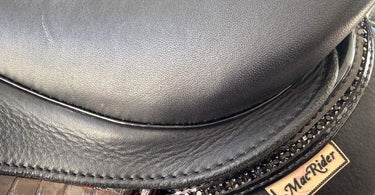
Cowhide is standard for large panels; horsehide is denser and breaks in more slowly. What matters at purchase is the cut: premium saddles use panels from the back and shoulder, where fiber structure is tightest.
Saddle Tree Construction Explained: What Holds the Leather Together
The saddle tree is the rigid frame that distributes the rider's weight across the horse's back; leather quality means nothing if the tree twists, pinches the wither, or fails to clear the spine.
Tree Material |
Weight |
Adjustability |
Typical Service Life |
Best For |
|---|---|---|---|---|
Traditional laminated wood |
Heaviest |
Fixed after build |
Long, but can warp if soaked |
Traditional builds, restoration work |
Fiberglass over wood |
Moderate |
Limited |
Moderate |
Budget and mid-range saddles |
Carbon fiber |
Lightest |
Adjustable on the spot |
Long, resists moisture |
Performance and custom fitting |
Carbon fiber trees are the benchmark for dressage and jumping saddles; the MacRider dressage line, including the Olympic and Regent, uses an advanced carbon fiber tree adjustable on the spot, so a fitter can correct width as a horse's muscling changes.

The most expensive mistake in saddle buying is choosing by brand reputation and assuming the fit will work out. A premium saddle that sits too narrow on a wide, well-muscled horse will cause the same back soreness as a cheap one. Always fit the tree and gullet to the horse first, then judge the leather.
Judging a Premium Leather Saddle Before You Buy
You can assess leather quality in about ten minutes with your hands and eyes.
- Press the flap with your thumb. Full-grain springs back with fine, tight creases; corrected-grain creases in broad, shallow folds or not at all.
- Compare grain across two panels. Natural grain varies; identical, uniform panels mean corrected or coated leather.
- Check edge finishing. Premium saddles have burnished or hand-stitched edges; painted or raw edges crack first.
Structurally: does the tree match your horse's back profile, can it be adjusted as muscling changes, do the knee blocks move, and is the twist narrow enough for your hips?
How Saddle Purpose Changes the Leather You Should Choose
Dressage saddles reward deep, flexible leather that lets the leg hang long and close; jumping saddles reward a firmer flap that holds shape in two-point; trail and endurance saddles need abrasion resistance above all. Fit for the discipline you compete in most, or choose a close-contact mono-flap with adjustable blocks, the MacRider Regent is built this way, with an extra-wide channel for spinal clearance and a medium seat that supports a long dressage leg without collapsing in two-point.

How to Care for Premium Leather Saddles
Premium leather rewards routine care and punishes neglect faster than cheap leather, because no plastic coating hides the damage.
Chrome-tanned and pigmented leather: wipe down weekly, use a pH-balanced cleaner then a light conditioner; pigmented finishes resist water better but dry quickly once the pigment wears through.
Wool-flocked panels: brush off dried sweat and dirt after every ride, never soak them, and have flocking checked by a fitter once or twice a year for a horse in full work.
Full-Grain vs Top-Grain Leather for Saddles
Full-grain leather keeps the complete outer surface of the hide, including grain and natural markings; top-grain has that layer sanded away, leaving a smoother, thinner, less breathable surface. For saddles, full-grain is correct every time.
Property |
Full-Grain |
Top-Grain |
|---|---|---|
Fiber strength |
Highest, grain intact |
Reduced, outer layer removed |
Breathability |
High |
Low, often surface-coated |
Break-in |
Gradual, molds to horse and rider |
Faster, then stops changing |
Patina |
Develops depth over years |
Minimal, finish wears instead |
Repair |
Can be conditioned and re-oiled |
Limited once the finish wears |
Appearance |
Natural markings visible |
Uniform, corrected surface |
Top-grain suits a wallet or car seat, where uniformity matters more than breathability, but on a saddle it gives up both breathability and fiber strength.
Fit, Break-In, and Comfort for Horse and Rider
A premium leather saddle breaks in over roughly 20 to 40 hours, molding to the horse's back and the rider's seat; cheap leather breaks in fast and then stops changing. Vegetable-tanned full-grain is slowest to break in with the longest service life and deepest patina; chrome-tanned full-grain is faster but less patinated; corrected-grain or split leather is quickest and shortest-lived.
What Premium Leather Costs Over Its Service Life
A premium leather saddle costs more up front and less per year than a cheap one, once you look at service life rather than sticker price. A saddle on a carbon fiber tree with wool-flocked panels and full-grain leather can be re-flocked, re-oiled, and adjusted for years; one on a fixed tree with foam panels and corrected-grain leather ends when the foam compresses and the finish wears through.
Sourcing, Animal Welfare, and Environmental Impact
Vegetable tanning uses natural tannins, often from tree bark, and produces far less toxic waste than chrome tanning, which relies on chromium salts, one reason traditional saddle makers have stayed with it for centuries. For buyers who care about sourcing, ask a maker directly: where are the hides sourced and can the tannery be identified; is the leather vegetable-tanned, chrome-tanned, or a hybrid; and does the maker offer repair and re-flocking services?
Frequently Asked Questions
What type of leather is best for saddles?
Full-grain leather is the top choice for a premium leather saddle. It keeps the hide's natural grain intact, so it resists abrasion better and develops patina over years of use. Vegetable-tanned full-grain is common in dressage saddles because it holds shape and takes tooling well. Top-grain leather is sanded smooth for a uniform look but removes the strongest outer layer, so it wears faster under stirrup leathers and heavy riding.
How can you distinguish between top-grain and full-grain leather in saddles?
Look at the surface. Full-grain leather shows natural markings, slight color variation, and visible pores because the outermost layer is intact. Top-grain leather looks uniform and smooth with no grain imperfections, since that layer has been sanded away. On a saddle, check the flap and skirt: uneven tone and small scars signal full-grain, while a plastic-like evenness usually means top-grain or a corrected finish.
What role does the tree construction play in saddle quality?
The tree is the saddle's frame, and it decides fit, balance, and how long the saddle holds its shape. Carbon fiber trees, like those in MacRider's dressage models, stay light and can be adjusted on the spot to match a horse's back. A weak or poorly fitted tree causes pressure points and uneven wear on the leather panels, so tree quality matters as much as the hide itself.